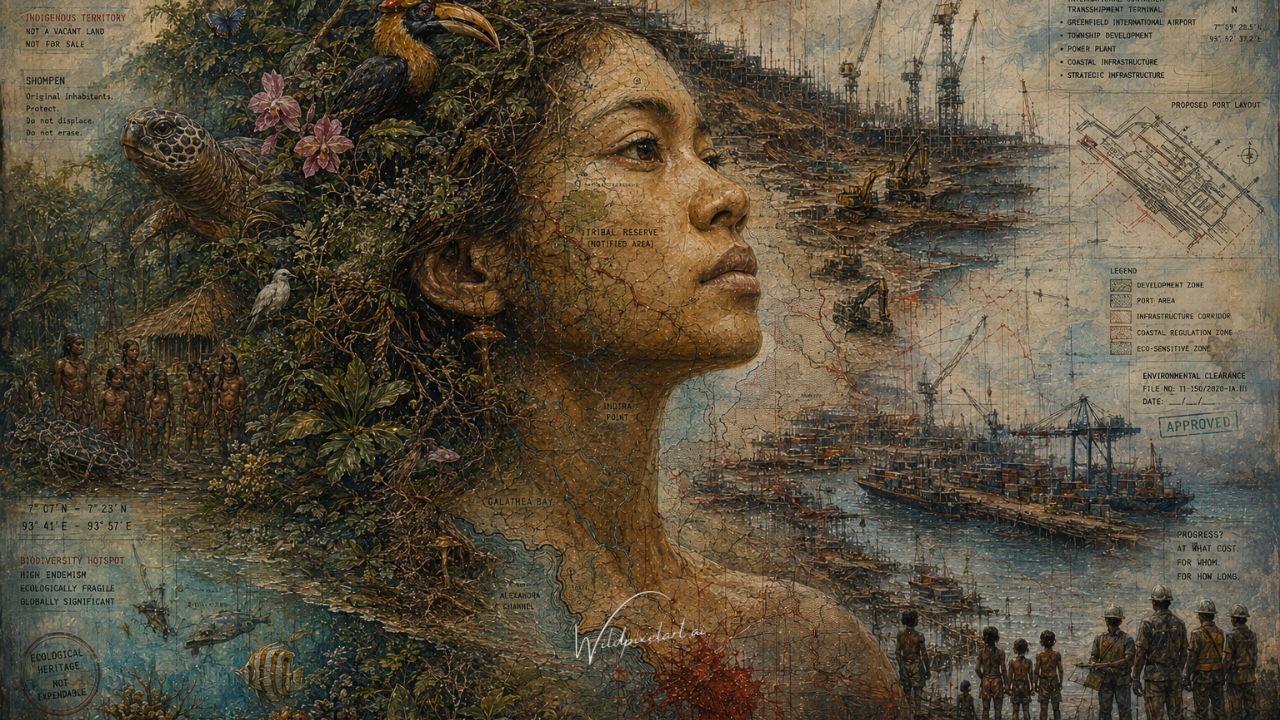
There are places on Earth that still work the way they always have — quietly, slowly, without waiting for human permission. Great Nicobar Island is one of them.
It sits at the southernmost tip of India's Andaman and Nicobar archipelago, about 150 kilometres from the northern tip of Indonesia. It is not particularly famous. Most people in mainland India could not place it on a map. But what lives there — the forest, the creatures, the people — has been building itself for far longer than any modern city.
Now the Indian government has proposed what it calls the Great Nicobar Development Project — a transshipment port, an international airport, a township, a power plant, and related coastal infrastructure. The logic is clear: the island sits near the Malacca Strait, one of the world's busiest shipping corridors. Whoever controls logistics here holds a significant position in Indo-Pacific trade.
That is a real strategic argument. The problem is what gets in the way of making it.
Tropical rainforests — among the least disturbed in South Asia
Leatherback sea turtle nesting beaches — one of the most significant in the Indian Ocean
Endemic species — plants, reptiles, birds found nowhere else on Earth
Mangroves and coral ecosystems — coastal protection, marine nurseries
The Shompen people — fewer than 300 individuals, one of the last semi-isolated indigenous communities in South Asia
The forest is not scenery. It is infrastructure.
The word "forest" carries a misleading image in the modern imagination. Trees. Greenery. Something beautiful to photograph from a distance. What tropical rainforests actually are is closer to a machine — a living system that regulates moisture, stores carbon, stabilises soil, protects coastlines, feeds marine ecosystems, and maintains the atmospheric conditions that make agriculture possible hundreds of kilometres away.
Island ecosystems are even more sensitive than mainland forests. The boundaries are fixed. Species cannot simply migrate when conditions change. Populations are smaller, recovery after disturbance is slower, and the relationships between organisms — which insects pollinate which trees, which birds carry which seeds — are tighter and more fragile.
This is why scientists consistently warn that island ecosystems do not need to be fully destroyed to begin collapsing. Roads, dredging, artificial lighting, shipping noise, invasive species arriving on construction vessels — any of these can disturb ecological relationships far beyond the immediate construction zone.
"The concern is not only about trees being cut. It is about the transformation of an entire interconnected system — one that took thousands of years to reach its current balance."
The giant leatherback sea turtle, for example, returns to the same beaches to nest that it was born on — sometimes crossing entire oceans to do so. Artificial lighting from a port or township near a nesting beach can disorient hatchlings permanently. Not through one catastrophic event. Through a slow, steady disruption that happens every night, silently, until one day there are no turtles left.
These are not hypothetical risks invented by activists. They are documented patterns, observed on islands around the world wherever large-scale development has been introduced quickly into sensitive ecosystems.
The Shompen — who they are and what is at stake
The Shompen people have lived on Great Nicobar for thousands of years. Not as visitors. Not as settlers. As the original inhabitants of that specific landscape, in the specific relationship with that specific forest.
Their movement patterns follow the seasons of the forest. Their food systems depend on what the rainforest produces. Their medicinal knowledge comes from plants that grow there and nowhere else. Their social structure evolved in a small community that does not have, or need, the institutional frameworks of a modern state.
The Andaman and Nicobar Administration's own 2015 Policy on the Shompen recognised all of this. It called for minimum intervention, controlled contact, and protection from large-scale outside intrusion. That policy existed for a reason — because history has shown, repeatedly and painfully, what happens when isolated peoples are rapidly exposed to the modern world without preparation or choice.
Disease comes first. Isolated communities have no immunity to common illnesses. The Andamanese people — another tribal group in the same archipelago — lost most of their population within decades of sustained British contact in the 19th century. Not through deliberate violence alone. Through the common cold. Through measles. Through contact.
Then comes dependency. When the forest that sustained a community is reduced or changed, the food systems collapse. People who survived independently for generations become dependent on supply lines they cannot control. And once that happens, there is no going back.
"Anthropologists are not romanticising isolation when they raise concern. They are responding to patterns documented across five centuries of colonial and post-colonial history."
It is important to say this plainly: the concern is not that the Shompen must remain frozen in time for the pleasure of outsiders. It is that any significant change to their environment or social structure must happen — if it happens at all — on their own terms, at their own pace, with genuine choice. A 72-hour public hearing, as reportedly held for the Great Nicobar project, is not meaningful consultation with a community that has had almost no prior engagement with formal administrative processes.
Development, law, and what protection actually means
The legal picture is contested. Environmental clearances for the project have been granted at various stages. Critics — including environmental lawyers, ecologists, and the Standing Committee of the National Board for Wildlife — have raised serious objections. Some clearances were challenged. Some objections were noted and overruled.
Recent amendments to forest and environmental clearance rules, including changes to the Forest Conservation Act, have been criticised by conservation groups who argue that the net effect is a weakening of ecological protection in favour of faster infrastructure approvals. The government maintains these reforms are necessary for national development and administrative efficiency.
This debate is not unique to India. Around the world, the same tension appears: between the speed at which economies need to grow and the speed at which ecosystems can absorb change. The problem is that these two clocks run at completely different rates.
A port takes five to ten years to build. The ecological consequences of that port — changes to currents, sedimentation, turtle nesting patterns, fish migration routes — unfold over fifty to a hundred years. The people who approved the project will not be alive to see the full consequences. The people and species who live in that ecosystem will have no choice but to absorb them.
Legal compliance does not automatically mean ecological safety. A project can receive every required clearance and still cause irreversible harm — especially in island ecosystems where long-term consequences are genuinely difficult to predict, and where the science is still incomplete.
This is not a reason to never build anything. It is a reason to build carefully, in the right places, at the right scale.
Why this matters far beyond one island
One of the most useful lies modern life tells us is that ecological destruction stays local.
It does not.
Forests influence rainfall patterns across regions. Coral reefs support fisheries that feed millions of people who live nowhere near them. Mangroves protect coastlines from storms and erosion in ways that benefit entire districts. Biodiversity loss reduces the genetic resilience of agricultural systems we depend on for food. These are not philosophical concerns. They are measurable, documented causal relationships.
The philosopher and writer Amitav Ghosh has observed that modern societies struggle to emotionally engage with ecological catastrophe because it happens gradually — slowly enough that each individual step looks manageable, even reasonable, until the cumulative effect becomes impossible to ignore or reverse.
Great Nicobar is not the last wild place on Earth. But it is one of the last in this part of the world. And what happens there — the precedent it sets, the institutional logic it either challenges or confirms — matters beyond that one island and those one set of turtles and those fewer-than-three-hundred people.
What actually needs to happen
This is not an argument against development. India needs ports. Economic growth matters. Strategic security in the Indo-Pacific matters. These are real things, not pretexts.
The question is not whether to build. The question is where, at what scale, with what genuine protections in place — and with honest acknowledgement of what is being permanently given up.
A few things that would make a real difference:
Cumulative ecological assessment, not just project-specific review. Individual clearances often miss systemic effects. The question is not just what this port does to this beach. It is what this port, plus this township, plus this airport, plus this road, plus the shipping traffic it generates, does to the entire ecological system over fifty years.
Permanently non-negotiable zones. Critical biodiversity areas and Shompen movement corridors should be legally protected in ways that cannot be administratively reinterpreted when the next project proposal arrives. Protection that can be waived under sufficiently strong economic pressure is not really protection.
Phased development with mandatory ecological monitoring. If the project proceeds, its expansion should be tied to measurable ecological outcomes, independently verified. Not self-reported compliance. Independent, transparent audits.
Genuine engagement with the Shompen — through anthropologists and indigenous rights specialists who have spent years building trust, not through a public notice and a 72-hour hearing window.
None of this is impossible. None of it makes development non-viable. It just makes it slower, more careful, and more honest about the costs.
The question we keep avoiding
The deepest issue raised by Great Nicobar is not really about one port on one island.
It is about whether technologically advanced societies still have the capacity — the moral and political capacity — to recognise ecological limits before they cross them. To decide, in advance, that some things are worth more than their economic value. To treat a living forest and a living people as something other than an obstacle between the present and a profitable future.
Civilisations throughout history have expanded by consuming landscapes faster than those landscapes could recover. What makes the present moment genuinely different is scale. Humanity now has enough technological power to alter entire planetary systems — not just individual islands, but the atmospheric and oceanic conditions that determine whether complex life continues to be possible here.
The cost of ecological collapse is never paid entirely by the generation that profits from the extraction. It is inherited — usually by people who had no say in the decision, and sometimes by species who had no idea the decision was even being made.
"Great Nicobar is not empty land waiting for transformation. It is a warning — about how modern civilisation measures value, defines progress, and decides what can be sacrificed in the name of the future." — WildPixelAI
The most uncomfortable possibility is this: the future being sacrificed, in the name of the future, may ultimately be our own.