There is something quietly unsettling about zero.
Not because it means "nothing." But because the moment we try to understand that "nothing," it stops being empty.
And that is where the story begins — and where this work began.
Zero was never just a number
For a long time, civilizations could count things — but not the absence of things. It took a conceptual leap to say: there is nothing here, and that nothing matters.
In the 7th century, the Indian mathematician Brahmagupta did something remarkable. He didn't just use zero as a placeholder — he gave it rules. He treated it like a number that could participate in arithmetic: addition, subtraction, multiplication.
That move changed mathematics forever.
It represents absence, yet behaves like presence.
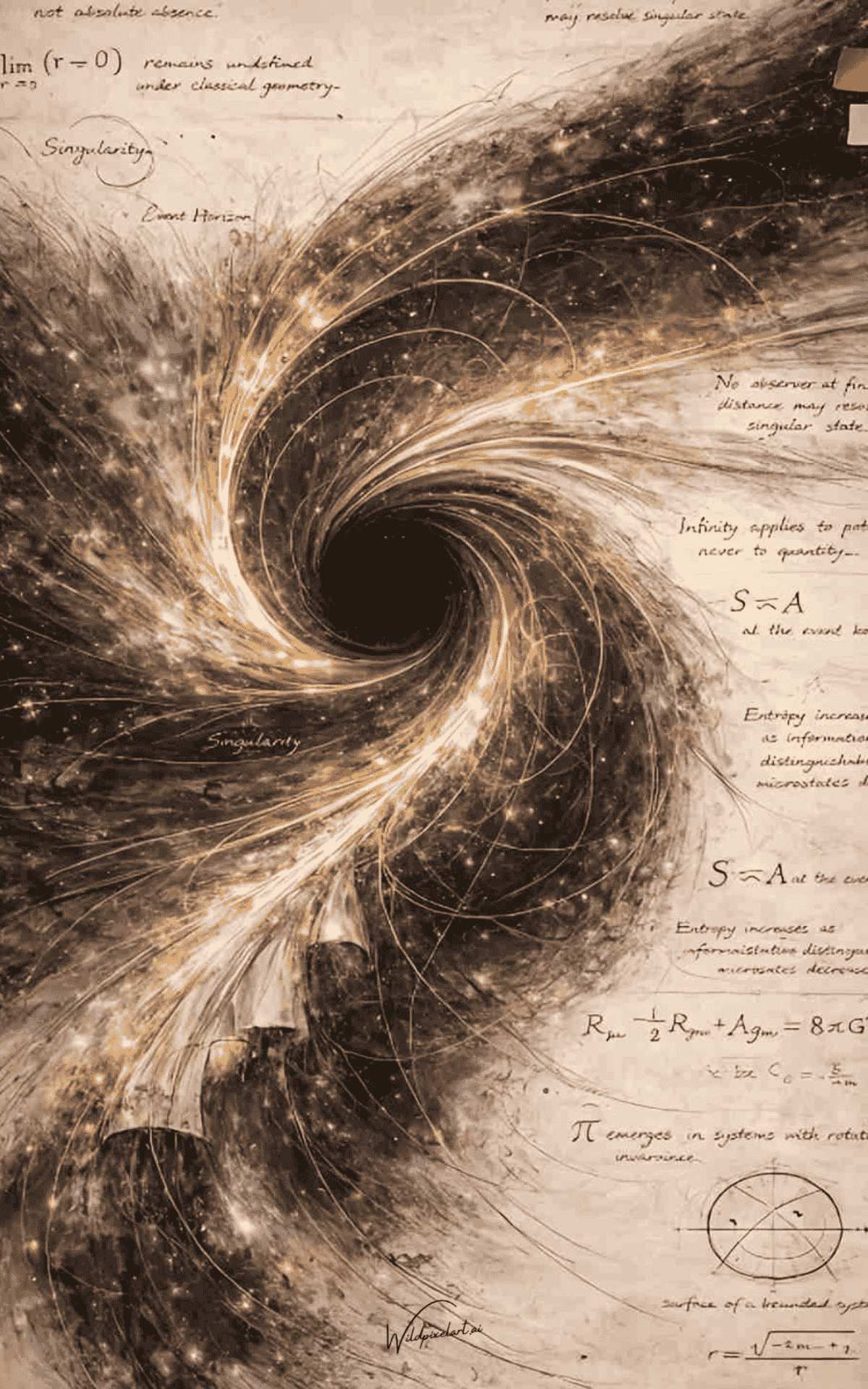
This tension — zero as both nothing and something — runs through every equation visible in this artwork. The handwritten notes in the background are real mathematical statements. Each one was researched, verified, and placed deliberately.
Infinity is not the opposite of zero
We often think of infinity as the far end of everything. But mathematically, it is not a number you can reach — it is a limit, a direction.
And something interesting happens when zero and infinity meet through limits:
1/x → ∞ as x → 0
This is not a coincidence. It shows a structural relationship. Zero and infinity are not simply opposites — they are connected through limits. Mathematicians formalise this in frameworks like the extended real line, where infinity is treated as a boundary rather than a value.
Why this matters for the artwork: The swirling structure you see in the piece is not decorative. It represents the event horizon of a black hole — the precise boundary where mathematics breaks down. Where zero and infinity collide in physical reality.
The brain had to learn "nothing"
What feels obvious to us wasn't always natural. Research by neuroscientist Andreas Nieder shows that the brain develops a representation for zero. Certain neurons respond specifically to the absence of quantity.
That means the mind does something subtle:
It encodes "nothing" as information.
This is not trivial. It is one of the reasons humans can think abstractly — and one of the reasons this subject felt worth visualising.
Zero is not truly empty in physics
If zero means nothing, then empty space should contain nothing. But quantum physics disagrees.
Due to the Heisenberg Uncertainty Principle, even a perfect vacuum cannot be completely still. Temporary appearances of energy fluctuate in and out of existence. This is called zero-point energy.
This is not philosophical speculation — it has measurable effects. The Casimir effect, confirmed experimentally, demonstrates that two uncharged metal plates placed very close together in a vacuum experience an attractive force. Something acts on them. Something that shouldn't exist in "nothing."
- Positive energy — matter, radiation, everything visible
- Negative energy — gravitational potential
- The sum — some cosmological models suggest it may be zero
Stephen Hawking wrote about universes whose total energy balances to zero — where conservation laws are never violated because there is, in a sense, nothing missing. Something came from a zero-sum accounting.
The art behind the equations
This piece began with a question: what does the concept of zero look like when it is taken seriously?
Not as an empty circle. Not as a placeholder. But as a live mathematical idea with real consequences — a boundary where our understanding of the universe breaks down.
Research took longer than the creation. The equations visible in the work are drawn from:
- Brahmagupta's arithmetic of zero (7th century India)
- Einstein's field equations (the R terms visible mid-right)
- Bekenstein-Hawking entropy formula (S ≈ A at the event boundary)
- Standard notations for limit behaviour as x approaches zero and infinity
The aesthetic choice — warm sepia and gold against deep space — was deliberate. Old parchment holding equations that describe things no human has physically seen. The ancient and the incomprehensible on the same surface.
AI shaped the final composition. But the research, the equation selection, the tonal choices — those came first.
A quiet thought to leave with
Zero is where we say nothing exists. Infinity is where limits disappear.
And yet, in both directions, the system keeps responding.
Maybe the question is not: what is nothing?
But: why does even nothing refuse to stay empty?
Questions about zero, infinity and this work
Who invented the concept of zero?
The Indian mathematician Brahmagupta, in the 7th century, was among the first to formalise zero as a number with its own rules in arithmetic — not merely a placeholder. Indian mathematics gave zero its operational identity.
Are zero and infinity related mathematically?
Yes. Through limits in calculus, as a value approaches infinity it tends toward zero, and vice versa. The expression 1/x illustrates this: as x grows toward infinity, 1/x approaches zero. They are structurally connected through limit theory.
What is zero-point energy?
Zero-point energy is the lowest possible energy a quantum system can have. Even in a perfect vacuum, quantum fluctuations persist due to the Heisenberg Uncertainty Principle — meaning "nothing" still contains something measurable. The Casimir effect demonstrates this experimentally.
What is the event horizon in the artwork?
The event horizon is the boundary around a black hole beyond which nothing — not even light — can escape. It is a real mathematical surface where known physics breaks down. In this artwork, it represents the point where zero and infinity meet in physical space.
Can I download or license this artwork?
Yes. A free watermarked version is available in the WildPixelAI gallery. Premium (clean 4K, personal print rights) and commercial licenses are coming soon. For urgent commercial enquiries, contact wildpixel26@gmail.com.