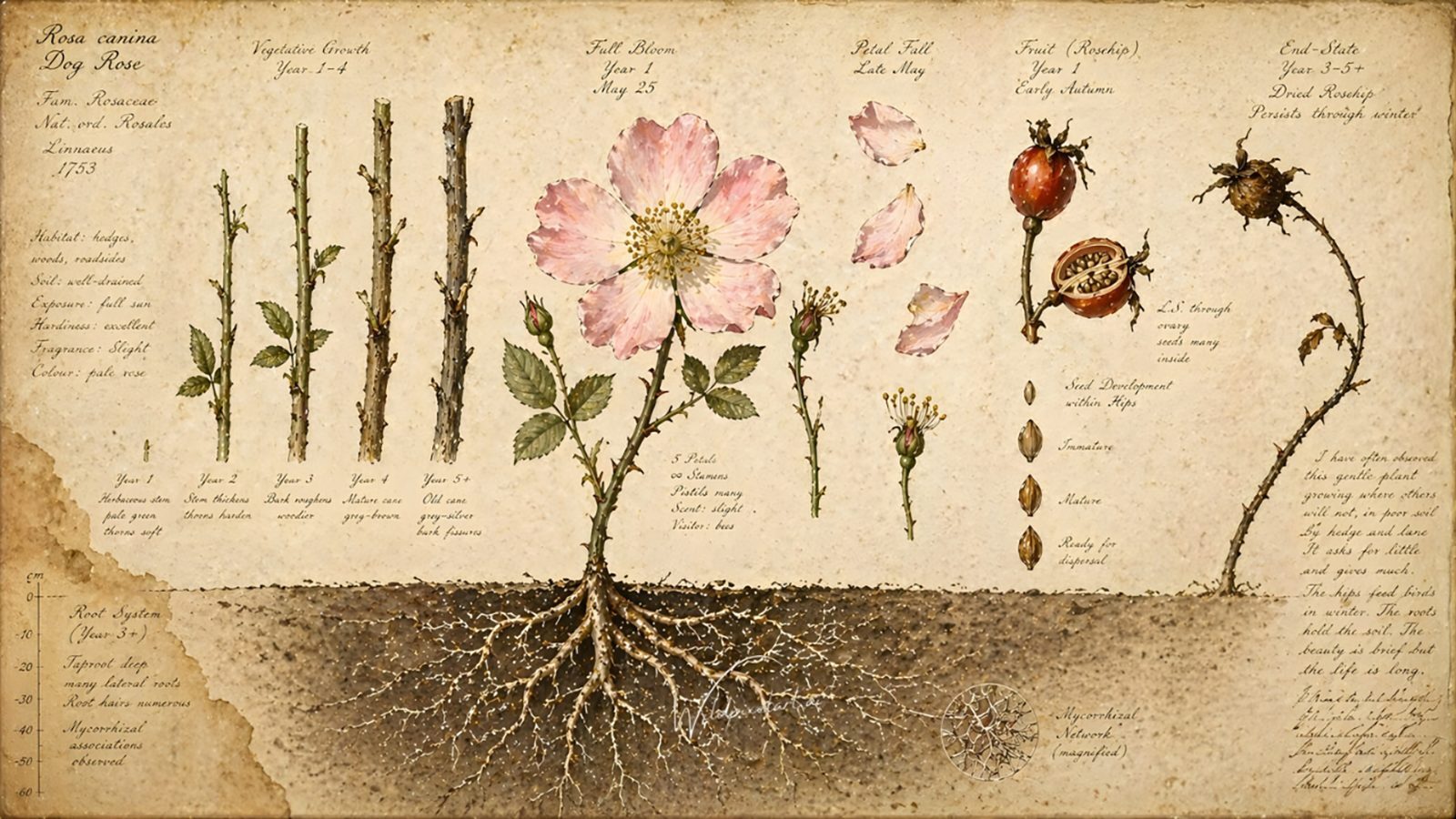
Rosa canina — Dog Rose · Botanical lifecycle illustration · WildPixelAI · Browse the Flora collection
There is a corner in my mother's bedroom — behind the door, where the light doesn't quite reach — and there is a small vase there that has not been moved in eleven years. Inside it, three dried roses. The original pink is gone. What's left is the colour of something that used to be red and decided, over a decade of quiet, to become mahogany instead. She never talks about them. She never throws them away. I never ask.
I think about that vase a lot.
We have been taught — somewhere between Pinterest and florist shop windows — that the most beautiful version of a flower is the moment it is fully open, fully alive, fully saturated with colour. We photograph that moment. We post it. We buy it in full bloom and watch it over five days move through beauty and into something we call dying and then we throw it away.
But I want to ask you something. When exactly did it stop being beautiful?
The first time I really looked at a dried flower — actually looked, not glanced — I was sitting on the floor of a friend's apartment in Bangalore at around 2am. She had this bunch of dried eucalyptus hanging above her bed on a copper hook. The leaves had gone silver-grey. The stems were the colour of old wood. And in the dark, with just the light from her reading lamp coming from the corner, the whole thing had become something that a living bunch of eucalyptus had never been: completely, absolutely itself.
No performance. No trying to stay open. No leaning toward light. Just the shape of what it had always been, finally visible without the distraction of being alive.
"Dried flowers are not flowers that failed to stay fresh. They are flowers that had the patience to become something more honest."
I think this is why certain people cannot throw them away. My mother is one. My grandmother was one. I am becoming one, slowly. There is a dried lavender bundle on my desk right now — it has been there for eight months. The purple has mostly gone. What's left is grey-lavender, the colour of late afternoon in October. The smell is still there, faint, the way a memory is faint — present enough that you know it's real, too soft to describe to someone who wasn't there.
I don't keep it because it's decorative. I keep it because something about it tells me the truth: that the beautiful version of most things is not the new version. It's the version that has lasted.
What happens inside a dried flower — the science nobody talks about.
When the water leaves — slowly, over weeks — the cell walls become thinner. More translucent. Light behaves differently inside a dried petal than inside a living one. In a living flower, the cells are full of water and pigment and they absorb and reflect colour in a specific way. In a dried flower, the water is gone. The cellular walls have thinned to something close to membrane. And light — if you catch a dried rose at exactly the right angle with exactly the right source — passes through it. Not around it. Through.
Copper. Amber. The specific colour of something that has held warmth for a long time and is now letting it out slowly.
Flemish still life painters of the 1600s deliberately included dried specimens alongside fresh flowers because they understood something we forgot: dried flowers glow differently — not less beautifully, but differently. They knew which flowers to backlight. They knew what drying reveals. We decided fresh was best and dried was sad. We were wrong.
Wabi-sabi — the beauty that only appears once the new is gone.
The Japanese have a concept called wabi-sabi. It's usually translated as "the beauty of imperfection" or "the beauty of impermanence" and both translations are correct and also slightly too clean. The real version is closer to: the beauty that only becomes visible once the new is gone.
A new ceramic bowl is nice. A ceramic bowl with a crack repaired in gold — kintsugi — is astonishing. Not despite the crack. Because of it. Because the crack is evidence of a life lived, and the gold is the decision to honour that evidence rather than hide it.
A dried rose is kintsugi. The colour is the gold.
The specific mahogany-brown of a rose that was once red. The silver-grey of lavender that was once purple. The bone-white of a chamomile that was once cream with a yellow centre. These are not failures of colour. They are the deeper colour underneath — the one that was always there, visible only once the surface colour has finished its job and stepped aside.
"The flower had two lives. The first one was for the bees. The second one is for you, if you're patient enough to wait for it."
I have a friend who keeps every bouquet she receives until it dries completely. Her apartment has bundles hanging from the ceiling in the kitchen, a vase of dried pampas on the shelf above her desk, pressed flowers between the pages of four or five books she reads often so she finds them by accident. She is not a maximalist. She is not performing some cottage-core aesthetic. She is someone who cannot bear to throw away something that is still beautiful just because it is no longer the version of itself that other people can see.
Those flowers have not stopped. They have started something else. They are moving through a second form of beauty that requires a different kind of looking — slower, closer, in the right light. Not the light of a florist shop. The light of 2am, in a room where you have been sitting long enough that your eyes have adjusted and you can see what is actually there.
How to actually see a dried flower.
The one thing I want you to try — just once, if you never have. Take a dried flower. Any kind. Rose is best but anything works. Take it to a window. Hold it up to the light from outside. Not backlit dramatically, just — hold it up so the light has to come through.
What you will see is the inside of the flower. The cellular structure. The veins that carried water when there was water to carry. The places where the petal was thicker, built for something, and the places where it was thinner, almost transparent now. The whole architecture of the thing, visible, because the water that was obscuring it is gone.
You are looking at what the flower always was. You just couldn't see it when it was busy being alive.
I think the reason people don't throw away certain flowers — even when they are completely dried, even when the colour is gone, even when the petals are so fragile that touching them makes them fall — is not sentiment, exactly. It is that they have seen something in the dried state that the living state could never show them, and they are not ready to stop seeing it.
The things we keep are not the things that stayed beautiful. They are the things that kept becoming beautiful — differently, slowly, in directions nobody planned for when they were first given or first grown or first cut and put in a vase.
That is not decay. That is what happens when something has the patience to stop performing and the dignity to simply remain.
There is a word for what dried flowers are, finally, honestly, without flattery: finished. Not finished as in done. Finished as in complete. As in every version of their beauty has now had its moment and what is left is the sum of all of them — copper and mahogany and silver-grey and bone-white and the exact particular smell of something that photosynthesised in a field somewhere and became, over months, this entirely itself thing on your windowsill.
Keep them longer. Look at them closer. Find the light that shows you what they actually are.
If you found this true in the way a memory is true — not something you learned, but something you already knew and forgot — then you already understand why certain flowers never get thrown away. They never get thrown away because they got more honest with time. And honest things are hard to let go of. We don't have enough of them as it is.